- POST a QUESTION or COMMENT about how to improve water pressure & flow.
InspectAPedia tolerates no conflicts of interest. We have no relationship with advertisers, products, or services discussed at this website.
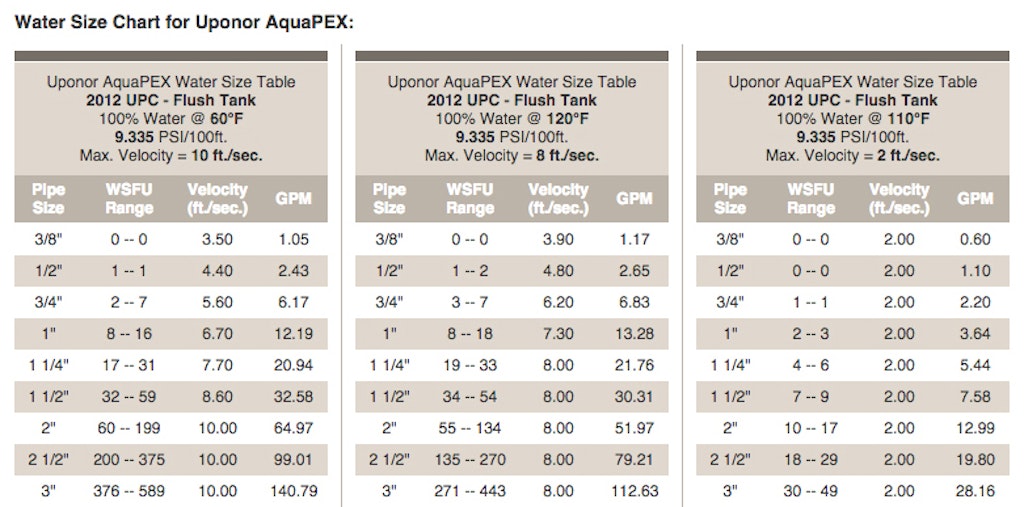
To increase the floor output for selected tubing size and length, the flow may need to be increased, the tubing spacing may be closer together, or an increase in water temperature. For example, by increasing the flow through 1/2″ PEX tubing by only 0.1 GPM, floor output will increase at 5 BTU/sq. For 1' tubing connections, Uponor’s ProPEX fitting has 12% greater internal diameter (i.d.) and 25% greater gallons-per-minute (gpm) flow rate than an insert fitting. This is particularly important with the increasing use of PEX in residential fire sprinkler systems, where lower-flow fittings may require larger tubing sizes and additional.
How to get more water 'pressure' or how to improve water flow rate (gpm or lpm).
This article series explains how to improve water pressure or flow rate and how to improve the total quantity of hot water available from your water heating system.
Page top sketch illustrating the effects of changes in pipe diameter, courtesy of Carson Dunlop Associates, a Toronto home inspection, education & report writing tool firm.
We also provide an ARTICLE INDEX for this topic, or you can try the page top or bottom SEARCH BOX as a quick way to find information you need.
Install Larger Diameter Water Supply Piping to Improve Hot Water Pressure & Flow
As we discussed at WATER PIPE CLOG REPAIR, and as we illustrate with Carson Dunlop Associates' sketch shown here, installing larger diameter water supply piping makes a large difference in the water flow rate.
In fact you can improve hot water flow in a building by replacing only part of the supply piping - perhaps that portion which is easily accessible. Installing larger water supply piping feeding the water heater may alone improve the hot water pressure and flow in the building.
[Click to enlarge any image]
Watch out: if your hot water is provided by a tankless coil, increasing water pipe diameter may not be of much use, and it could make matters worse!
A tankless coil (and also an instantaneous water heater) is normally rated by its manufacturer as capable of increasing water temperature to a desired level only if water flow through the coil is limited to a specific rate, perhaps 5 gpm. Flowing water through the tankless coil or instantaneous water heater too fast will mean that the water temperature may be too low at the fixture.
In sum, larger diameter piping increases water pressure and flow. It does not increase the total volume of hot water that is available from a water heater. This improvement may be of most value where water pressure is poor and where water piping has previously become clogged by rust or mineral deposits.
You may regain some of this loss by insulating hot water supply piping or by setting water heater or boiler temperatures higher as well as by an adjustment at
the HOT WATER MIXING VALVE.
Impact of Changing Pipe Diameter on Water Flow Rate
Question: how much water pressure will we lose if we replace copper pipe with PEX of the same nominal size
I have municipal water and a combination furnace. The bathroom shower has separate hot and cold faucets and a diverter from tub spout to shower head.
Recently I noticed that I was using less and less cold water to moderate the hot but only in the shower. The hot in the bathroom sink was still scalding so I knew it wasn't the thermostatic control valve at the furnace.
The only thing I could think it could be was the shower control unit. My thought was that even though the cold was off there was still some cold water somehow mixing with the hot. It had got to the point where you could comfortably take a shower just in hot water while the hot in the sink would scald my hand after a second.
The only logical explanation I could come up with was a failing control as suggested above.
So I have cut out the old unit and replaced it with a Glacier Bay (Home Depot) similar unit. I also replaced the cut out copper with pex and used shark bite fittings to complete the job.
Well, the hot water problem has gone but now I have lower pressure from the shower. I haven't changed the shower head itself, just a few feet of copper to pex, shark bites instead of soldered unions and the fitting itself. I can't say if the tub spout has also been negatively affected.
Do shark bites or pex piping reduce flow ?
Could the new fitting reduce flow, after all, it's a cheapo from Home depot ?
If the water is too hot, should I adjust the thermostatic control at the furnace so I can turn the hot water up in the shower and so increase the volume at the shower head ? That said, it was higher pressure in the old unit so where has that pressure gone ?
Reply:
Shark Bites won't make a notable difference in flow rate; they very slightly crimp the tubing. But as we'll discuss, the smaller ID of PEX tubing may constrict water flow up to ytour shower head.
If the internal diameter of the Pex piping were as large or larger than the piping that you removed and I would not expect it to make a difference in the flow rate. But of course we know PEX has a smaller ID than copper of the same nominal size.
Generally, before ripping out the PEX to go to the next larger size you may want to be sure other easier obvious fixes have been done.
Have you checked the shower head itself? Often mineral scale or debris clog the shower head; cleaning that may be enough.
Reader follow-up:
2020/01/02 Will said:
I have not, it didn't really make sense to me that when changing the fitting the shower would lose pressure because of a part I didn't change.
I'll put a new one on tonight and report back :-)
Also, PEX 1/2' seems to maybe have a slightly smaller internal diameter than copper 1/2' due to the thickness of the pipe wall.
Moderator reply: Calculating the reduction in pipe cross-sectional area when changing from Copper to PEX = Reduction in Water Flow Rate
Will
Thank you for asking a great question: how much difference to water flow does changing from Copper to PEX make if the nominal pipe sizes remain the same.
At WATER PIPE CLOG REPAIR we explain that as illustrated with Carson Dunlop Associates' sketch, installing larger diameter water supply piping makes a big difference in the water flow rate.
I am (sorry to say) far too familiar with the effects on water flow rate (popularly called 'water pressure') of reductions in the diameter of a supply pipe, thanks to a lazy local Poughkeepsie plumber who used 1/2' instead of 3/4' ID PEX on a job.
That reduction in diameter when changing to PEX or when including ANY PEX in the piping run can show up as a complaint of a weaker shower flow just as you’ve suggested.
In general, the greater the percentage of smaller diameter piping in a water system the greater the reduction in flow rate, all other factors (such as pressure, total piping length, number of elbows, valves, etc. ) remaining the same).
The ID of copper pipes is ROUGHLY 1/8 less than the OD. But the actual copper piping inside diameter (ID) number varies as across types L and M the OD stays the same.
'Type K tube has thicker walls than Type L tube, and Type L walls are thicker than Type M, for any given diameter. All inside diameters depend on tube size and wall thickness.' - copper.org cited below
- Nominal 1/2” K Copper: OD: 0.625” ID: 0.527” Wall: 0.49” Cross-Sectional Area: 0.218”
- Nominal 3/4” K Copper: OD: 0.875” ID: 0.745” Wall: 0.65” Cross-Sectional Area: 0.436”
- Nominal 1/2” PEX: OD: 0.625” (same as copper), ID: 0.485” (0.005” smaller than copper), Wall: 0.70” Cross-sectional area: (pi r squared = area of a circle & r= 1/2 diameter): (3.1416 x 0.2425 (squared)) = 0.185”
- Nominal 3/4' PEX: OD: 0.875” (same as copper), ID: 0.681” (0.064” smaller than copper), Wall: 0.097” Cross-sectional area: .364”
Percent decrease in cross sectional area going from copper to PEX
Percent decrease in cross sectional area going from copper to PEX is about the same as the percent reduction in water flow through the piping, if all other factors are kept equal:
- 1/2” PEX = 15% less cross-sectional area & flow rate than 1/2” copper [ 1 - (0.185 / 0.218) x 100 ]
- 3/4” PEX = 16% less cross-sectional area & flow rate than 3/4” copper [ 1 - (0.364 / 0.436) x 100 ]
Pressure Drop When Using a Smaller Pipe Size
Pexuniverse gives nominal pressure drosp in psi per 100 ft. of tubing length for several flow rates from which we excerpt below.
At Flow Rate of 1 GPM
- 1/2” PEX has a pressure drop of 1.70 gpm per 100 ft. of run
- 3/4” PEX has a pressure drop of 0.34 gpm per 100 ft. of run.
This is very significant as it illustrates that a reduction of 1/4' in the ID of PEX going from 3/4' down to 1/2' tubing will give a net change in pressure drop of (1.70 - 0.34) or 1.36 gpm over a 100 foot run (all else unchanged).
That's a 400% greater pressure drop per 100 ft. of run when going to one nominal smaller pipe diameter smaller. The numbers for copper piping pressure drop as diameter changes will be similar.
Ilustration courtesy of Carson Dunlop Associates discussed further at CLOGGED SUPPLY PIPES, REPAIR
Research on Plumbing Pipe Size vs Flow Rates
- ASTM-F876 “Crosslinked Polyethylene (PEX) Tubing
- COPPER TUBE HANDBOOK [PDF] at inspectapedia.com Copper Development Association, Inc., 7918 Jones Branch Dr., Suite 300, McLean VA 22102 USA Website: https://www.copper.org/ Original source: https://www.copper.org/publications/pub_list/pdf/copper_tube_handbook.pdf
- PEX TUBING TECHNICAL SPECIFICATIONS [PDF] PEX Universe.com (Sales of PEX tubing) Tel: 800-818-3201 original source: https://www.pexuniverse.com/pex-tubing-technical-specs
- SharkBite Plumbing Solutions, SharkBite USA 2300 Defoor Hills Rd. NW Atlanta, GA 30318 USA Tel: 1-877-700-4242
SharkBite Canada 74 Alex Avenue Vaughan, Ontario, L4L 5X1 Canada, tel: 1-888-820-0120 retrieved 2020/01/19 original source: https://www.sharkbite.com/
SHARKBITE INSTALLATION GUIDE [PDF] (2018) Reliance Worldwide Corporation 2300 Defoor Hills Rd NW, Atlanta, GA 30318 Phone: 1-877-700-4242 Fax: 1-877-700-4280 rwc.com Reliance Worldwide Corporation (Canada) Inc. 74 Alex Avenue Vaughan, Ontario, L4L 5X1 Phone: 1-888-820-0120 Sales Inquiries: canadasales@rwc.com Orders: canadaorders@rwc.com retrieved 2019/08/13 original source: https://www.sharkbite.com/sites/g/files/rgohfh321/files/2018-05/SharkBite_Installation_Instructions_2018_WEB.pdf
Reader Comments & Q&A
On 2020-05-18 by Gowtham
I need a fogging calculations . With 14 por 12 fogging nozzels 80 littes of water has to be consumed for 9 hours.which motor and nozzels are adviced .
Presently i used half hp submercible pump 6mm numatic pipes and 0.2mm 7 nozels.its consuming 80 ltrs of water by 6.30 hrs.
I have done many experiments on this .now i want to change to 1/4 hp motor .i thought this may increase more time.
Can someone suggest me.
Iam doing it for disinfection tunnel.
Disinfection liquid is costly so iam trying it do a fog .
On 2020-02-10 - by (mod) -

Will
Thanks for the follow-up as that will help other readers;
On 2020-02-10 by Will
OK, so I finally got around to at least changing the shower head for the cheap plastic one that came with the fitting. Before putting it on I drilled out the restrictor and it's made a huge improvement. So perhaps the PEX isn't an issue after all :-)
On 2020-01-07 - by (mod) -
If you take a look at the explanation above on this page you'll see the effect of replacing part of water piping with a larger diameter.
Let's take it step by step doing the easy things first as we've been discussing.
On 2020-01-07 by Will
You said 'About going to 3/4' copper throughout, that gives much greater delivery rate of water but may not be necessary; As Carson Dunlop's sketch on this argues, often replacing just the accessible part of supply piping with larger diameter makes a big difference'
Does that statement suggest that if I take the 1/2' hot water supply from the furnace and a couple of feet away from that connection to the furnace I convert the 1/2' to 3/4' I will see a noticeable difference if I keep that 3/4' all the way to the shower fitting where it has to go back to 1/2' to connect to the shower fitting ? Doesn't the fact that the supply from the furnace starts out as 1/2' cause a bottleneck that isn't corrected when the diameter increases further down the line then decreases again at the fitting.....or doesn't water pressure/flow work that way ?
Meantime, I'll remove the restrictor, hadn't even occurred to me. Thanks
On 2020-01-06 - by (mod) -
Will
You can also stay with PEX but go to the next larger size, with proper adapters to connect it to your existing piping.
About the shower head: it is probably a low-flow shower head as most are currently; at low water supply pressure systems where going to a low-flow shower head gives unacceptable water flow for bathers, I either pull out the restrictor in the shower head (usually it's right in the screw-on fitting) or if necesssary I drill out the opening into the shower head at its connector.
About going to 3/4' copper throughout, that gives much greater delivery rate of water but may not be necessary; As Carson Dunlop's sketch on this argues, often replacing just the accessible part of supply piping with larger diameter makes a big difference. I'd go step by step.
On 2020-01-06 by Will
And, furthermore, would you recommend swapping out all hot and cold water lines for 3/4' copper ? I might have a problem doing that with the hot as it comes from a combi furnace and I believe the only hot outlet is 1/2' so making it 3/4' a foot from the 1/2' outlet and then maintain 3/4' all the way to the faucets/shower would be a waste of time, correct ?
In any event, the shower fitting itself is 1/2' so wouldn't that create it's own bottleneck anyway ?
Thank you for the assistance and the subsequent comments on the theory that the PEX is causing a lower pressure at the shower head. I have now since swapped out the shower head for a brand new head, albeit low budget, from Home depot. If anything the pressure is even lower than before. I have to assume that the PEX is causing a reduction in volume which manifests itself as low pressure at the shower head.....I guess I'm getting some soldering practice in the near future. Low shower pressure is a pet peeve of mine.
...
Continue reading at CLOGGED SUPPLY PIPES, DIAGNOSIS or select a topic from the closely-related articles below, or see the complete ARTICLE INDEX.
Or see these
Recommended Articles
- PEX BRASS CONNECTOR LEAKS build-up in brass elbows & tees that can clog PEX piping systems
- WATER QUANTITY IMPROVEMENT - steps to increase well yield or other means to improve water flow into the well itself
Suggested citation for this web page
WATER SUPPLY PIPE DIAMETER vs FLOW at InspectApedia.com - online encyclopedia of building & environmental inspection, testing, diagnosis, repair, & problem prevention advice.
Or see this
INDEX to RELATED ARTICLES: ARTICLE INDEX to WATER HEATERS
Or use the SEARCH BOX found below to Ask a Question or Search InspectApedia
...
Ask a Question or Search InspectApedia
Questions & answers or comments about how to improve hot water quantity and flow rate from a residential hot water heating system.
Try the search box just below, or if you prefer, post a question or comment in the Comments box below and we will respond promptly.
Search the InspectApedia website
Note: appearance of your Comment below may be delayed:if your comment contains an image, web link, or text that looks to the software as if it might be a web link, your posting will appear after it has been approved by a moderator. Apologies for the delay.
Technical Reviewers & References
- ...
Books & Articles on Building & Environmental Inspection, Testing, Diagnosis, & Repair
- Our recommended books about building & mechanical systems design, inspection, problem diagnosis, and repair, and about indoor environment and IAQ testing, diagnosis, and cleanup are at the InspectAPedia Bookstore. Also see our Book Reviews - InspectAPedia.
- ...
- Carson, Dunlop & Associates Ltd., 120 Carlton Street Suite 407, Toronto ON M5A 4K2. Tel: (416) 964-9415 1-800-268-7070 Email: info@carsondunlop.com. The firm provides professional HOME INSPECTION SERVICES and also extensive HOME INSPECTION EDUCATION and home inspection-related PUBLICATIONS. Alan Carson is a past president of ASHI, the American Society of Home Inspectors.
Thanks to Alan Carson and Bob Dunlop, for permission for InspectAPedia to use text excerpts from The Home Reference Book & illustrations from The Illustrated Home. Carson Dunlop Associates' provides extensive home inspection education and report writing material.
The ILLUSTRATED HOME illustrates construction details and building components, a reference for owners & inspectors.
Special Offer: For a 5% discount on any number of copies of the Illustrated Home purchased as a single order Enter INSPECTAILL in the order payment page 'Promo/Redemption' space.
TECHNICAL REFERENCE GUIDE to manufacturer's model and serial number information for heating and cooling equipment, useful for determining the age of heating boilers, furnaces, water heaters is provided by Carson Dunlop Weldon & Associates
Special Offer: Carson Dunlop Associates offers InspectAPedia readers in the U.S.A. a 5% discount on any number of copies of the Technical Reference Guide purchased as a single order. Just enter INSPECTATRG in the order payment page 'Promo/Redemption' space. - The HOME REFERENCE BOOK - the Encyclopedia of Homes, Carson Dunlop & Associates, Toronto, Ontario, 25th Ed., 2012, is a bound volume of more than 450 illustrated pages that assist home inspectors and home owners in the inspection and detection of problems on buildings. The text is intended as a reference guide to help building owners operate and maintain their home effectively. Field inspection worksheets are included at the back of the volume.
Special Offer: For a 10% discount on any number of copies of the Home Reference Book purchased as a single order. Enter INSPECTAHRB in the order payment page 'Promo/Redemption' space. InspectAPedia.com editor Daniel Friedman is a contributing author.
Or choose the The HOME REFERENCE eBook for PCs, Macs, Kindle, iPad, iPhone, or Android Smart Phones.
Special Offer: For a 5% discount on any number of copies of the Home Reference eBook purchased as a single order. Enter INSPECTAEHRB in the order payment page 'Promo/Redemption' space. - Building inspection education & report writing systems from Carson, Dunlop & Associates Ltd
COMMERCIAL BUILDING INSPECTION COURSES - protocol ASTM Standard E 2018-08 for Property Condition Assessments
HOME INSPECTION EDUCATION COURESES (Canada)
HOME INSPECTION EDUCATION COURSES (USA) including home study & live classes at eleven colleges & universities.
HOME INSPECTION EDUCATION: HOME STUDY COURSES - ASHI@Home Training 10-course program.
Special Offer: Carson Dunlop Associates offers InspectAPedia readers in the U.S.A. a 5% discount on these courses: Enter INSPECTAHITP in the order payment page 'Promo/Redemption' space. InspectAPedia.com editor Daniel Friedman is a contributing author. - The Horizon Software System manages business operations,scheduling, & inspection report writing using Carson Dunlop's knowledge base & color images. The Horizon system runs on always-available cloud-based software for office computers, laptops, tablets, iPad, Android, & other smartphones
Find out why this colorful tubing is the up-and-coming plumbing trend that has DIYers excited.
Photo: istockphoto.com
Cross-linked polyethylene (PEX), a type of flexible plastic, is currently replacing traditional copper and galvanized steel as water supply lines in both new construction and remodeling projects. You’ve probably seen rolls of blue and red PEX pipe in the plumbing aisle of your local home improvement store, but might not know that this colorful tubing now makes it possible for enthusiastic DIYers to replace their own leaky water lines instead of calling a pro. Read on to learn more about PEX—what it is, where it can be used, and all the pros and cons of this popular plumbing material.
PEX, Past and Present
In 1968, German scientist Thomas Engle discovered a way to crosslink common plastic (polyethylene) through radiation to produce a much suppler form of the material. The new plastic, fashioned into flexible PEX pipe (also known as PEX tubing), arrived in the US in the 1980s, initially for radiant floor heating systems: The flexible tubing is embedded in a concrete slab and hot water pumped through to heat the slab and radiate heat to rest of the room. PEX pipe remains popular for radiant floor heating.
Photo: homedepot.com
While PEX use for water supply systems has been widespread in Europe since the 1980s, it was a latecomer here because some early versions deteriorated slightly when exposed to the high chlorine levels common in US water supplies. Adding antioxidants during manufacturing made PEX suitable for carrying drinking water and, over the past two decades, having met our potable drinking water standards, it started catching on.
Complaints about early PEX water systems cropped up when the fittings used to connect the pipes failed and leaked. Improved fittings solved that problem and the popularity of PEX surged. Today, PEX is used in more than 60 percent of new construction residential water supply systems.
PEX Particulars
PEX is available in a variety of lengths, from short 10-foot pieces (for small repairs) to rolls over 500 feet long, which are used to install a home’s entire water supply system. PEX pipe ranges from 3/8- to 1-inch in diameter and its color-coding makes it a snap to identify what a specific pipe is used for. Although there are three types of PEX (see Label Lingo, below), the different colors don’t connote the distinctions; they simply make it easy for the installer to identify which lines carry hot water and which carry cold.
- Red PEX pipe carries hot water.
- Blue PEX pipe carries cold water.
- White PEX pipe can be used for either hot or cold water.
- Gray PEX pipe, like white, can be used for either hot or cold water (although not all DIY centers carry gray).
Fantastic Flexibility
Traditional copper and galvanized steel water systems feature main lines and a series of smaller branch lines that lead to each fixture. Each branch that attaches to the main line requires a separate connection. PEX has a distinct advantage over these materials because of its flexibility, which allows one end of PEX pipe to connect to a PEX manifold (the main water control system) and then wind through walls and floors—uninterrupted—all the way to an individual fixture. Called “homerun” plumbing, by using a single length of PEX for each hot and cold water supply fixture in your home, it eliminates the risk of leaks at multiple connection sites.
Photo: istockphoto.com
Benefits and Drawbacks
Beyond flexibility, PEX has other advantages—and two main considerations.
PROS
- Installing PEX does not require soldering as does copper and galvanized steel.
- PEX expands, making it more resistant to freeze-cracking than either copper or steel.
- PEX does not corrode, which can happen with both copper and steel pipes, leading to leaks and contamination of the water supply.
- Water flows silently through PEX, eliminating the “water hammer” noise associated with metal piping.
- Color-coding (red and blue) make it simple to distinguish hot and cold supply lines.
- PEX can be connected to existing metal supply lines with the correct fittings.
CONS
- PEX is not suitable for outdoor use. Ultraviolet rays cause PEX to break down quickly—tubing left outdoors can harden and crack within a couple of months.
- PEX cannot currently be recycled, because it does not melt as other recyclable plastics do. With the popularity of PEX rising, however, the demand for a way to recycle it will also likely rise.
- Though installation is DIY-friendly, working with PEX requires special connectors and tools.
Photo: istockphoto.com
Label Lingo
The different types of PEX are distinguished by the manufacturing process used to make the tubing. When shopping for PEX, you may notice rolls labeled with either an A, B, or C designation. Choose the tubing best suited to your needs:
- PEX-A is manufactured using peroxide. This type of PEX is the most flexible of the three types and is suitable for use in all home water-supply plumbing needs. It expands to the greatest degree when subjected to freezing water, so it’s the most resistant to cracking in frigid temperatures. It’s easy to work with but it’s more expensive than B or C. A 10-foot piece of PEX-A runs $3.50 to $7.50, depending on brand and diameter. Other than flexibility, PEX-A has no significant benefit over PEX-B.
- PEX-B is manufactured using a moisture-cure method. PEX-B is slightly stiffer than PEX-A, and has a distinct coil “memory” that makes the tubing want to return to its original coiled state. The coil memory, however, is not a hurdle to installation, and PEX-B is often the tubing of choice for residential plumbing because it also expands to resist cracking when water freezes but is less expensive than PEX-A: A 10-foot section of PEX-B runs $2.50 to $5.50, depending on brand and diameter. PEX-B also features an increased resistance to chlorine, making it a good choice in areas where water is highly chlorinated.
- PEX-C is manufactured via an irradiation method. Because it’s the stiffest version, PEX-C is the most difficult to work with; this stiffness also makes it most prone to kinking, as well as susceptible to cracking when water freezes. These undesirable traits make PEX-C best suited for short repairs where bending around sharp corners isn’t necessary. PEX-C is the most economical choice, with a 10-foot section running $1.75 to $3.50, depending on brand and diameter.
Photo: homedepot.com
Making PEX Connections
Pex Gpm Calculator
To make watertight connections with PEX pipe, you’ll need the right tools and supplies. For each of the following methods of connecting, the fittings and connectors must be an exact match to the size of the PEX pipe. Hundreds of types of fittings, usually brass, are available for connecting PEX to existing copper or steel pipes, and for making connections to fixtures. Fittings are also available for connecting pipes of different sizes. The following five methods are used for making the connections watertight.
Pex Sizes Guide
Photo: amazon.com
- Copper crimping: One of the most common ways of connecting PEX is with copper crimping rings (view on Amazon), which requires the use of a special PEX crimping tool (view on Amazon). The copper ring slips over the end of the PEX tube, and a fitting is then inserted into the PEX tube. The copper ring is then pushed to the end of the tube—over the fitting—and a PEX crimping tool is used to crimp the copper ring (and tube) tightly in place.
- Expansion connections: The expansion method of connecting PEX involves using a special PEX expander tool (view on Amazon) to stretch the diameter of the PEX tube before inserting the end of a fitting. The PEX tube then shrinks back to its original size to create a water-tight seal around the fitting.
- Stainless steel clamps (SSC): The SSC method of connecting PEX involves using a ratchet clamping tool to tighten stainless steel rings around PEX connections (view on Amazon). Similar to the copper crimping method, the steel ring is slipped over the PEX tube before the fitting is inserted. The ratchet clamping tool is then used to squeeze a tab on the ring, which tightens the ring securely around the tube and the fitting.
- Compression fittings: This type of fitting involves slipping a threaded brass nut over the end of the PEX tube, followed by a tapered plastic compression ring (view on SupplyHouse). A hollow brass tube is then inserted into the end of the PEX tube. The whole thing is then inserted into the end of a threaded fitting and the threaded brass nut is then screwed onto the end of the fitting. As the nut is tightened, it squeezes the plastic compression ring against the end of the brass fitting to create a seal.
- Push-fit connections: The quickest way to connect PEX is with the push-fit method, which involves purchasing special push-fit fittings that “grab” the end of the PEX pipe when inserted over the end (view on Amazon). No special tools are required to use push-fit fittings, but a special removal ring is required to remove them from the end of the pipe once you’ve connected it. As a child, if you ever played with one of those paper tube “traps” that grabbed your finger when inserted into the tube, you get the idea of how push-fit connecting works.
Gpm Of Pex Pipe
PEX Usage Tips
- For the best results, use only the recommended tools for making PEX connections. For example, you won’t get as tight a fit if you try to use pliers to crimp a connecting ring as you will by using a PEX crimping tool.
- Store PEX indoors and away from a sunny window since the pipe degrades in UV light.
- Use a PEX cutter to make clean end cuts that will be easier to work with.