Here’s a roundup of six of our favorite leadership styles along with the strengths, weaknesses of each and examples of leaders who adopted the style. Transformational Leadership. 6 Leadership Styles Robyn Benincasa is a two-time Adventure Racing World Champion, two-time Guinness World Record distance kayaker, a full-time firefighter, and author of the new book, HOW WINNING WORKS: 8 Essential Leadership Lessons from the Toughest Teams on Earth, from which the following article is excerpted.
- It can be difficult to understand the different styles of leadership and when to use them, but the better a leader knows which styles they can and should use, the more effective their team will be. Here’s six leadership styles and how they affect performance: 1. Most of the time, a coercive leadership style is not the best approach.
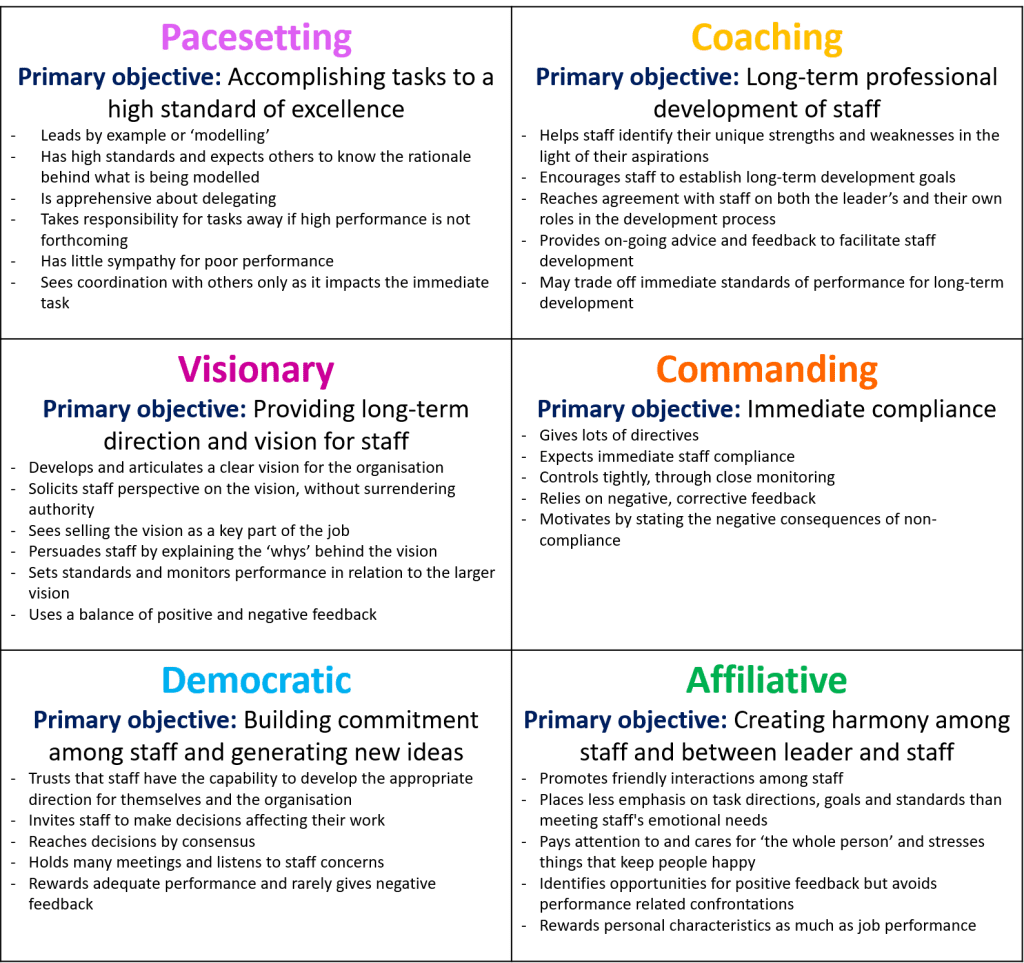
- The Six Leadership Styles (Goleman) Commanding Visionary Affiliate Democratic Pacesetting Coaching The leader's modus operandi Demands immediate compliance Mobilizes people towards a vision Create harmony and builds emotional bonds Forges consensus through participation Sets high standards for performance Develops people for the future.
- Goleman’s ‘Six Leadership Styles’ There is some dispute about exactly how many leadership styles there are out there, but psychologist Daniel Goleman presents a good case for his six. They are: Commanding – Someone who demands immediate compliance. Visionary – Someone who mobilizes people towards their vision.
Do you know what type of leadership style you use at your company?
Strong leaders can drastically change people's lives. Hence, it's not hard to believe that leadership skills influence our organisation' success.
Luckily, just like other management skills, one can learn and grow their leadership skills.
This article examines the six most common leadership styles. Which one do you think fits your organisation?
Coercive leaders are seen as micromanagers by creative employees.
Coercive leadership style

With 'do what I say' as their coercive motto, the coercive leader is full of initiative and self-control.
Coercive leaders tend to:
- demand instant compliance,
- perform well during a crisis,
- kickstart change/motivate; and
- confront problematic employees.
However, this leadership style can be destructive for more creative employees and projects. Even though their followers usually feel safe and guided, creative employees may lose motivation and resent micromanagement.
Authoritative leadership style
The visionary leader is known as a more creative and eccentric teacher. With a 'come with me' approach, they lead the organisation into their vision of success.
A visionary leader possesses self-confidence and emotional intelligence, and they ooze charisma and enjoy expressing their ideas with clarity and passion.
Affiliative leadership style
Known as the carer, this leader puts people first, focusing on creating a harmonious working environment and developing emotional bonds.
This leadership style demands lots of empathy and the ability to forge relationships through a range of communication styles.
This leader is incredibly helpful during stressful situations, and they can help to motivate employees to endure through hard times. The carer can also heal issues within a team and form new groups.
However, this leader struggles when it comes to improving poor performance and may be more reluctant to give advice.
The carer prioritises the people and harmonious working environment.
Democratic leadership style
'So, what do you think?' is a phrase this type of leader loves to say. Known as the listener, they work hard to develop agreement through participation, using excellent collaboration and communication skills to lead their team.
With their love for surveys and feedback, this leader relies heavily on their team's opinions. These leaders are usually able to combine views and ideas from valuable employees and leaders to their advantage. This style is effective in managing change and an agile workforce.
Pacesetting leadership style
This leader has high expectations, and they want assignments completed yesterday. With 'Do as I do and do it now' as their motto, they are known as the hustler.
This approach is perfect for extremely competent and motivated teams, working to tight deadlines. Beware, do not use this leadership style to everyday environments and less-pressured settings.
This leader's drive to succeed and their healthy initiative is undoubtedly admirable. Still, be careful. This leader is so passionate and disciplined that they could intimidate and unknowingly pressure employees.
The mentor brings out the best in people
Coaching leadership style
With an eye on the long-term, this leader focuses on developing others. Most people refer to them as the mentor. 'Try this.' 'Go on, try some more...' With a great sense of self and focus on the individual, the mentor works on the premise that every step is progress.
This leadership style is the right way to bring out the best in people. The mentor adjusts yet pushes the bar for consistent growth while allowing the employees to learn new skills that will propel the business forward.
Great mentors understand their team and accept that they, just like other people, are continually learning.
Which one is your leadership style?
We instinctively lean towards one or two leadership styles. We should not stay with one because a leader who sits in-between leadership styles delivers the best results.
Try to use different techniques from the leadership styles you identify most with, making sure you adjust to the particular situation.
In the end, it comes back to knowing your team, their strengths, communication methods and challenges. You should also nurture your culture, values and vision. You will see substantial results once you have learned to lead your team.
Source: breathe HR
Related articles
How to Deal with a Procrastinating Employee
From Basic Salary to Minimum Wage: All About Pay in Malaysia
3 Company Leave Application Form Templates for HR
Leading from Your Seat
One important aspect of understanding your leadership style is realizing you don’t have to be in a conventional leadership role, CEO or executive, to be a leader. Because there are 6 leadership styles it is important to have the self-awareness to know which one you are.
In a recent interview with Renee Doty, Manager of Community Affairs with the EDC of Wayne County, who has her Master’s degree in communication and has done research on leadership, offers this advice to anyone interested in strengthening their leadership abilities. Renee says you can lead from the seat you currently hold, even if you don’t have a formal leadership title. This empowers you to speak up and make changes. Not every leader can be out in the spotlight “some leaders give the speeches while other leaders write speeches.” Being a leader is not confined to your job, you can be a leader in any part of your life.
“Some leaders give the speeches while other leaders write speeches.”
Renee DotyLeadership Styles 6
Doty emphasized that it is important to know your weaknesses as a leader “instead of ignoring them (weaknesses), strengthen and acknowledge them.” Leaders should be mindful of themselves, but should also understand that they bring with them a unique perspective that allows them to tackle challenges.
These are crucial concepts to understand when studying about your leadership style. It requires self-search and awareness that may highlight your weaknesses. This is not something to shy away from, Doty stated “The faster you can get to know yourself the faster you can find your place. People would be stronger leaders with self-reflection.”
What Are Leadership Styles?
What are leadership styles? They are behaviors that a leader displays while leading. Individuals display different leadership behaviors much like personality behaviors. While you are inclined towards one leadership type or another, this does not mean you can’t change your leadership style. With increased self-awareness, you can capitalize on the best parts of your leadership style to be the most effective leader possible.
What is my leadership style? This is the first question that all bosses, managers, or executives should ask themselves. Improvement of your leadership is impossible without learning your leadership behaviors. One Google search will tell you there are many different leadership styles and many opinions on the best ones.
In a study conducted by the Harvard Business Review, there are six most effective leadership styles. These include some of the initial leadership styles theorized by Kurt Lewin in 1939. Lewin’s theory of leadership initiated more research on the subject. After 80 years of research, there are many types of leadership styles that combine behaviors from different styles. In a blog article by Range, they even explain how to find your leadership style with multiple different personality assessment tools such as the Enneagram.
All leadership styles have pros and cons. Not every leadership style is effective in all working environments. Emotional intelligence is one of the most important assets that a leader can possess. It allows them to be as effective as possible in any work environment, with any team.
The 6 Leadership Styles
As a side note, there are various other types of leadership. Leadership styles may also have different names. These are the six that we are focusing on in this article.
Coercive
- Coercive: Coercive leaders are always in charge of the situation. Therefore, they can make decisions with little input from others. This is an important role in stressful situations or crises. This form of leadership does tend to make employees feel undervalued or unheard which can be detrimental. Employees feeling unappreciated can cause major setbacks in all work environments. Coercive leaders are needed to make the hard and quick decisions. In times of peace, this leadership style can have negative effects. on employee satisfaction. Read more to learn about making employees feel heard.
Authoritative
- Authoritative: Authoritative leaders like coercive leaders are in charge of the situation. These types of leaders can be described as firm, but fair. This leadership style is well suited for environments where a clear direction is needed. For instance, employees that need an engaged leader that always knows what everyone is doing. Authoritative leaders create change quickly and efficiently with each employee knowing their specific tasks. In an environment where employees do not need clear directives, this type of leadership style can feel like a micromanager.
Affiliative
- Affiliative: Affiliative leaders focus on people. Above all, they create strong bonds with employees and give them constant praise. These types of leaders have very loyal employees and a positive work environment. This is not a stand-alone leadership style because it can promote poor performance and productivity. These leaders may be prone to leave out constructive criticism in the hope of creating a positive work environment. Affiliative leadership in combination with another style can be very effective.
Democratic
- Democratic: Democratic leaders focus on feedback. They encourage feedback and meetings with their team. This allows them to build trust with their employees to get open and honest responses. Respect is another important part of leadership. This has a positive impact on motivating employees to do their best. This can be an ineffective style of leadership in times of duress when quick decisions need to be made.
Coaching
- Coaching: Coaching leaders focus on growth. They act as more of a coach for their employees than a boss. These are leaders not always seen in traditional business roles. They focus on the improvement and growth of their employees. The positive impact is this style of leadership builds up individuals so that they can perform well on their own as well as with their team. This leadership style is not effective in every work environment, including one with employees who may have an unwillingness to learn.
Pacesetting
- Pacesetting: Pacesetting leaders lead by example. They show their employees exactly what they want them to be doing. Above all, these leaders are highly effective in their positions and expect the same performance from all of their employees. The positive impact of this is it leads to competent employees. Meanwhile, the negative impact is this leadership can lead to competitiveness and lead to an uncomfortable work environment.
Best Leadership Styles
The success of the 6 leadership styles depends on the environment. It is important to understand that an effective leader needs to be able to switch between leadership styles with ease. Each employee may require a different kind of leadership to meet their maximum potential. An effective leader moves through each style but most likely has a style that they always come back too. Leadership styles in business may look different than those in other fields because the business sector is vast.
Six Leadership Styles Examples
How Emotional Intelligence Can Help You
One key component of understanding your leadership style is emotional intelligence. Psychologist Daniel Goleman, author of Emotional Intelligence: Why it can matter more than IQ, states that emotional intelligence can be more important than cognitive intelligence. It is important to keep this in mind when trying to understand your leadership. Four qualities that people with high emotional intelligence display are compassion, authenticity, respect, and confidence. Similarly, effective leaders competently engage with their employees read how to effectively engage with those you are leading.
These are all qualities that are found dispersed through the 6 leadership styles. The goal of understanding your emotional intelligence and leadership style is to create your leadership style. “There is no right way to lead. If there was someone would have found it by now. The most fool-proof formula for effective leadership is:
- Evaluating your emotional intelligence
- Understanding your leadership style
- Using the trial and error method to achieve the best possible results
If you need some help deciding what your leadership style is take this short quiz.
About the Author
Rebekah Corwin is a senior public relations and psychology double major at Anderson University interning with Stratavize for the summer. Find her on LinkedIn.
Six Leadership Styles Chart
Finally, Want to hear more from the Stratavize Team? Sign up to join our Monthly Insights & Spotlights for a monthly email.